A Project of Department V: Theology and Archaeology
Prof. Dr. Manfred Oeming
For five years, theologians from Heidelberg have participated in archeological excavations in Ramat Rahel (Jerusalem), led by Prof. Manfred Oeming. In 2008 they made the remarkable discovery of 15 large silver coins from Second Temple times.
Moreover, the team discovered discovered a trove of byzantinian coins, a royal palace, and an Arabic caravansary.
All in all 80-120 people participate in these excavations, which take place annually during summer. Among them are 20 to (as of last year) 53 students from Heidelberg (75% theologians, also students from the College for Jewish Studies, students of archeology and various fields in ancient history, but even in medicine and law) and numerous additional volunteers from all over the world. The site of exploration, Ramat Rahel, is the most southern part of Jerusalem and has been settled for 1700 years before modern times. As the work has proceeded, more and more aspects of this exceedingly fascinating place have come to the fore.
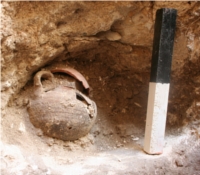
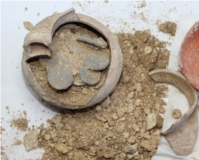
In July 2008, students from Heidelberg discovered a small cooking pot of clay from Roman times. It was located in a nook on the ground of a columbarium, a subterranean dovecote. In ancient Israel pigeons were bred for profane nutrition or for cultic sacrifices in the Temple of Jerusalem. The metal detector reacted strongly, and to everybody's surprise the jar contained 15 large silver coins, so called Tyrian shekels, dating from the time of the destruction of the Second Temple (9th Av 70 CE). In the 150 years of archeology in Palestine, only seven similar troves have been discovered - a fact that added to everybody's excitement.
Prof. Oded Lipschits (Tel Aviv University), who co-leads the excavation and participated with 20 students from Tel Aviv, explains how such such a pot could have ended up on the floor of such a cave. "The pot was haphazardly covered with earth. Obviously somebody was in a hurry hiding it, planning to come back later to recover the trove. Presumably the reason was the destruction of the Temple by the Romans. However, something must have happened to the person, for he or she did not return."
The trove of silver coins is not the only "treasure" discovered by the German-Israeli team of archeologists. Another accumulation of artefacts dates from Byzantinian times (5th-7th century CE), containing 380 coins as well as 70 further ones found on the stone ground in the direct surrounding. But even beyond that we were lucky to be surprised by discoveries, for example an unknown building from Persian times measuring 33 to 20 meters (about 100 to 60 ft), a palace by antique standards. The estate also included a royal garden, 700 sq.m (ca. 7,500 sq.f) of which have been excavated and which includes a refined water supply using a complex system of pools, pipelines, and subterranean tunnels. An Arabic Abassid caravansary (9th-12th century)was also found. The newly found artefacts include numerous smaller items, such as rare and valuable coins,ioncluding one from Persian times and two coined under Pontius Pilate, a lead casket for a child, a golden amulet containing malachite, as well as a Byzantine wristlace and a Sassanid seal stamp. Dozens of stamped jug handles bear inscriptions (for example, "lmalk," "for the king," and "jhud", "Juda").
As more and more fascinating details about Ramat Rahel are emerging, yet questions remain. The Biblical name of the place continues to be a matter of debate, including suggestions as Bet-Keren ("Wineham"), Mamshīt, Kimham's lodging place, Baal's house, Rama, or Bethlehem-Ephrata. At any rate, in the beginning (ca. 700 BCE) there was a royal citadel and a palace of David's sons of considerable extent, ca. 6,000 sq.m (roughly 65,000 sq.ft). The precise function of this fortified palace is unclear: A luxury place for the wives (a Harem?), summer palace or residene of the Assyrian rulers? In Persian times (538-332 BCE) Ramat Rahel certainly was an administrative center with an idyllic "paradise"-garden. In Hasmonean times there was a Jewish setlement with pools for ritual baths (miqvahs), later it was the location of a mansion with a bath from late Roman times, a Byzantine monastry with a church, and finally an Arabic building from the times of the Abassids (8th - 12th century).
The finds are highly significant in historical regard, but also for German-Israeli and Jewish-Christian relations.