








Prinzip ‚Personifikation’
Visuelle Intelligenz und epistemische Tradition, 1300 – 1800
Dr. Cornelia Logemann
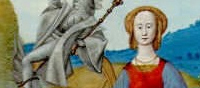
Das Bedürfnis, dem Abstrakten Gestalt und insbesondere Sichtbarkeit zu verleihen, begegnet seit dem ausgehenden Mittelalter in Europa immer wieder. Nicht nur Francesco da Barberino beschreibt in seinen Documenti d'amore die Vorzüge der visuellen Ebene: Scheint sie doch der Sprache vor allem durch die Möglichkeit der Affektstimulation überlegen. Die Voraussetzung ist allerdings, daß die zeichenhafte Oberfläche einer Personifikation vom Betrachter verstanden werden konnte. So steht die personifizierte Tugend in Europa seit der Antike für die Diskontinuität der Zeichen - im Gegensatz zur stets wankelmütigen Fortuna, die durch semantische Kontinuität besticht. Ihren göttlichen Status büßen beide Figuren im Christentum ein. Doch während Fortuna ihre heidnische Autorität und kulturelle Andersartigkeit zumindest teilweise behaupten kann, wird Virtus in den frühneuzeitlichen Deutungsmechanismen komplett entkleidet und immer wieder neu ausgestattet. Doch vor allem gilt es, zwischen verschiedensten Rezipientengruppen zu differenzieren. Für humanistisch gebildete Lateinkenner und für die von Gregor dem Großen zur Zielgruppe von Bildern stilisierten idiotae hatte beispielsweise ein und dieselbe Personifikation eine gänzlich unterschiedliche Bedeutung. Der eine sah mit historischem Bewußtsein und beträchtlicher Vorbildung; der andere, ohne das Wissen über die Herkunft mancher Zeichen und ohne ein ausgebildetes Bewußtsein für Fremdes und Eigenes, konnte nur identifizieren, was seinen Sehgewohnheiten entsprach. Werden die Gottheiten der Antike durch Artefakte einerseits, durch literarische Aufbereitung andererseits salonfähig und ihre Semantik für bestimmte Gruppen also kulturell wahrnehmbar, bleiben komplexere Personifikationen in anderen Kontexten enigmatisch, da sie nicht dechiffriert werden können. Fremdes wird dann nur als unbekannt definiert - wenn nicht die ästhetische Oberfläche der Personifikation ihrer Deutung zuarbeitet. Die Wahrnehmung von Personifikationen in Skulptur und Malerei ist an beständig variierende Gruppen gebunden. Bildkonzepte, die sich an elitäre (und eben national übergreifende) Kreise richten, etwa in exklusiveren humanistischen Zirkeln, koexistieren mit simpleren visuellen Ausdrucksmitteln, die nationale Identität beschwören oder in christlich-religiösem Kontext stehen. Allein dies bezeugt die Pluralität kultureller Identitäten, die sich insbesondere an der Denkform Personifikation ablesen läßt.

Zur Person:
Dr. Cornelia Logemann
Universität Heidelberg
Transcultural Studies
Marstallstraße 6
69117 Heidelberg
Tel.06221 54-7854
Fax: 06221 54-7862
logemann@uni-heidelberg.de
Vita
Studium der Kunstgeschichte, französischen Literaturwissenschaft und Ethnologie an der Universität Hamburg 1995 bis 2001; 2001 bis 2006 wissenschaftliche Mitarbeiterin der Forschernachwuchsgruppe ‚Stimme – Zeichen – Schrift’ am Zentrum für Mittelalter- und Frühneuzeitforschung der Universität Göttingen, 2003 Stipendium am Deutschen Historischen Institut in Paris, Promotion 2005 an der Universität Hamburg mit einer Arbeit zu Handlungsräume – Zeichenräume. Die Vie de Saint Denis und die französische Buchmalerei des 14. Jahrhunderts; zwischen 2007 und 2008 Forschungsstipendium der Gerda-Henkel-Stiftung, SS 2008 Lehrbeauftragte an der Universität Regensburg; seit WS 2008/09 Leiterin der Nachwuchsgruppe ‚Prinzip Personifikation’.
Publikationen
Monographien:
Heilige Ordnungen. Die Bild-Räume der Vie de Saint Denis und die französische Buchmalerei des 14. Jahrhunderts [pictura et poesis 24], Köln/Wien 2009.
Sammelbände:
Körper-Ästhetiken. Allegorische Verkörperungen als ästhetisches Prinzip (gemeinsam mit Miriam Oesterreich und Julia Rüthemann), Bielefeld 2013.
Götterbilder und Götzendiener. Europas Blick auf fremde Religionen (gemeinsam mit Maria Effinger und Ulrich Pfisterer), Ausst.kat. Heidelberg, Heidelberg 2012.
Cesare Ripa und die Begriffsbilder der Frühen Neuzeit (gemeinsam mit Michael Thimann), Berlin 2011.
Übertragungen. Formen und Konzepte von Reproduktion in Mittelalter und Früher Neuzeit (gemeinsam mit Albrecht Hausmann, Britta Bußmann und Annelie Kreft), Berlin 2005.
Text und Handeln. Zum kommunikativen Ort von Minnesang und antiker Lyrik (gemeinsam mit Albrecht Hausmann und Christian Rode), Heidelberg 2004.
Aufsätze:
Bernard Picarts Cérémonies et coutumes religieuses de tous les peuples du monde und das Konzept der Ausstellung, in: Götterbilder und Götzendiener. Europas Blick auf fremde Religionen, hg. v. Maria Effinger/Ulrich Pfisterer/Cornelia Logemann, Ausst.kat. Heidelberg, Heidelberg 2012, S. 8-21 (gemeinsam mit Ulrich Pfisterer).
Allegorie im Atelier: Körperbilder in der amerikanischen Skulptur nach 1900, in: Körper-Ästhetiken Allegorische Verkörperungen als ästhetisches Prinzip, hg. v. Cornelia Logemann/Miriam Oesterreich/Julia Rüthemann, Bielefeld 2013, S. 55-84.
„Alles muss seine Ordnung haben: Fremde Götter und bekannte Allegorien“, in: Maria Effinger/Ulrich Pfisterer/Cornelia Logemann (Hg.), Götterbilder und Götzendiener. Europas Blick auf fremde Religionen, Ausst.kat. Heidelberg, Heidelberg 2012, S. 117-130.
„Mantel der Bilder – Mantel der Gedanken. Ripas Anti-Integumenta“, in: Cesare Ripa und die Begriffsbilder der Frühen Neuzeit, hg. von Cornelia Logemann und Michael Thimann, Berlin 2011, S. 167-198.
„Falsche Augenzeugen. Fingierte Echtheitsbeweise in spätmittelalterlicher Geschichtsschreibung“. In: Wolfram Drews; Heike Schlie (eds.): Zeugen und Zeugenschaft. Perspektiven aus der Vormoderne. München: Wilhelm Fink Verlag (Reihe Trajekte), 2011. S. 77-98.
„Herrschaft als Rollenspiel. Allegorische Darstellungsverfahren im Spätmittelalter“, in: Das Mittelalter. Perspektiven mediävistischer Forschung. Themenschwerpunkt: Visibilität des Unsichtbaren, hg. von Anja Lutz, Berlin 2011, S. 103-136.
„Des Königs neue Räume. Genealogie und Zeremoniell in französischen Bilderhandschriften des 14. Jahrhunderts“, in: Ausmessen – Darstellen − Inszenieren. Aneignung, Schaffung und Wiedergabe von Räumen in Mittelalter und Früher Neuzeit,hg. von Barbara Schmidt und Regula Schmidt-Keeling, Wiesbaden 2007, S. 41-72.
„Übergänge“, in: Übertragungen. Formen und Konzepte von Reproduktion, hg. von Britta Bußmann, Albrecht Hausmann, Annelie Kreft, Cornelia Logemann, Berlin u. a. 2005, S. 371-376.
„Heilsräume – Lebensräume. Vom Martyrium des heiligen Dionysius und einem paradiesischen Paris“ (Paris, BN, Ms. fr. 2090-92, Ms. lat. 13836), in: Marburger Jahrbuch für Kunstwissenschaft 30 (2003), S. 53-91.
Artikel im Druck:
The invented audience: Allegorical power of persuasion as visual strategy, in: The Public in the Picture / Das Publikum im Bild Involving the Beholder in Antique, Islamic, Byzantine and Western Medieval and Renaissance Art /Beiträge aus der Kunst der Antike, des Islam, aus Byzanz und dem Westen, hg. von Beate Fricke und Urte Kraß, Berlin/Zürich 2014.
Les vêtements des dieux antiques à l’aube de la Renaissance: Cultes anciens et nouvelles images, in: La Vertu des Païens, hg. von Sylvie Taussig, Turnhout 2015 [im Druck].
Weltkunst in Frankreich, in: Kunstgeschichte der Vier Erdteile, hg. von Matteo Burioni und Ulrich Pfisterer, Darmstadt 2015 [bei den Herausgebern].
Baupläne der Andacht. Meditative Architekturen in der Buchmalerei des 14. Jahrhunderts, in: Orte der Imagination – Räume des Affekts: die mediale Formierung des Sakralen (1100-1600), hg. von Elke Koch und Heike Schlie, München 2013 [im Druck].
„CivicVirtue. Eine marmorner Tugendheld in New York und sein Publikum“, in: Körperbilder in Kunst und Wissenschaft, hg. von Simone Schütz-Bosbach und Wolf Schmidt, Berlin/New York 2013 [im Druck].
„Bild, Buch und Raum. Perspektiven einer spätmittelalterlichen Heiligenlegende“, in: Kanon Kunstgeschichte. Eine Einführung in die Kunstwissenschaft, hg. von Kristin Marek und Martin Schulz, München 2012 [im Druck].
„Personifikation und die Stufen des Erkennens. Das Beispiel spätmittelalterlicher Tugenddarstellungen“, in: Die Oberfläche der Zeichen. Bildallegorien der frühen Neuzeit in Italien und die Hermeneutik visueller Strukturen, hg. v. Klaus Krüger, Wolf Löhr, Ulrike Tarnow, München 2009 [im Druck].
Gestickte Geschichte. Der Teppich von Bayeux als Visualisierung zeitgenössischer Ereignisse. In: Bilder machen Geschichte, hrsg. v. Uwe Fleckner, München [im Druck].
Lexikonartikel:
Art. ‚Neugierde und Staunen’. In: Ulrich Pfisterer (ed.): Lexikon der Kunstwissenschaft. Stuttgart: Metzler, 2003. S. 248-252.
Art. ‚Tugend’, in: Handbuch der politischen Ikonographie, hg. von Uwe Fleckner, Martin Warnke und Hendrik Ziegler, 2 Bde., München 2011, Bd. 2, S. 473-481.
Art. ‚Allegorie und Personifikation’, in: Lexikon der Kunstwissenschaft, hg. von Ulrich Pfisterer, Stuttgart 2011 (2. erw. Aufl.) S. 14-19.
Katalogbeiträge:
Katalogbeiträge in: Divina officia. Liturgie und Frömmigkeit im Mittelalter, hg. von Patrizia Carmassi, Herzog-August-Bibliothek Wolfenbüttel, 2004, S. 83-85 (Nr. 8) und S. 176-180 (Nr. 29).
Katalogbeiträge in: Götterbilder und Götzendiener. Europas Blick auf fremde Religionen (gemeinsam mit Maria Effinger und Ulrich Pfisterer), Ausst.kat. Heidelberg, Heidelberg 2012, S. 131-134 (I.1), S. 151 (I.14), S.184 (II.25), S.256 (IV.16), S. 261-263 (IV.20), S. 265-266 (IV.23), S. 268-269 (IV.25), S. 306-308 (V.23).
Rezensionen und Tagungsberichte:
Rez. von: Richard H. Rouse u. Mary A. Rouse, Manuscripts and their Makers: Commercial Book Producers in Medieval Paris 1200 – 1500. Illiterati et uxorati. 2 Bde., Turnhout 2000, in: Das Mittelalter. Perspektiven mediävistischer Forschung, Bd. 6, Heft 2 (2001), S.166-167.
Rez. von: O’Meara, Carra Ferguson: Monarchy and consent. The Coronation Book of Charles V of France. British Library MS Cotton Tiberius B.VIII, London 2001, in: Das Mittelalter. Perspektiven mediävistischer Forschung, Bd. 7, Heft 2 (2002), S. 227-229.
Tagungsbericht: IMITATIO ARTIS im Mittelalter. Dresdner Arbeitsgespräche zur Kunstgeschichte II (6. und 7. Februar 2004),(gemeinsam mit U. Pfisterer), in: http://www.arthist.net/download/conf/2004/040220Logemann_Pfisterer.pdf. (pdf)
Rez. von: Conrad Rudolph (ed.): A Companion to Medieval Art: Romanesque and Gothic in Northern Europe, Oxford: Blackwell Publishing 2006, in: sehepunkte 7 (2007), Nr. 4 [15.04.2007]. URL: http://www.sehepunkte.de/2007/04/13060.html .
Rez. von L’Estrange, Elizabeth, Holy Motherhood. Gender, Dynasty and Visual Culture in the Late Middle Ages (Mancester Medieval Studies), Mancester / New York 2008, Mancester University Press, XVII u. 282 S., in: ZeitschriftfürHistorischeForschung. Vierteljahresschrift für die Erforschung des Spätmittelalters und der Frühen Neuzeit 37 (2/2010), S. 273-275.
Rez. von Metternich, Wolfgang: Teufel, Geister und Dämonen. Das Unheimliche in der Kunst des Mittelalters, Darmstadt 2011, in: http://hsozkult.geschichte.hu-berlin.de/rezensionen/2012-1-022.
